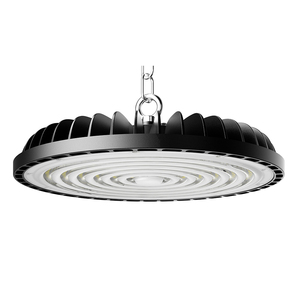
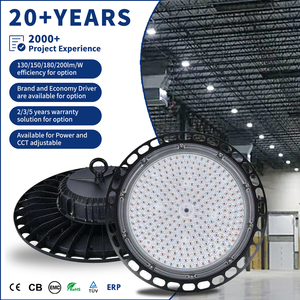
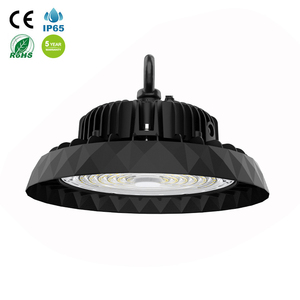
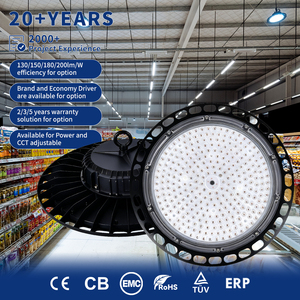
Specification-grade OEM/ODM luminaires manufactured under ISO 9001:2015 and verified by TÜV Rheinland & Intertek photometric labs.
The global industrial lighting sector is undergoing a massive paradigm shift. Sourcing highbay luminaires from Chinese manufacturers is no longer merely a game of finding the lowest unit cost per fixture. For global B2B procurement directors, electrical wholesalers, lighting specifiers, and EPC contractors, the priority has shifted toward Total Cost of Ownership (TCO), System Efficacy (lm/W), Photometric Precision, and Supply Chain Risk Mitigation.
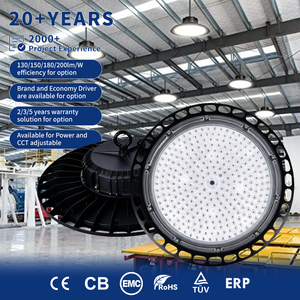
Historically, market standard UFO LED highbays operated at an average efficacy of 100 to 130 lumens per watt with basic aluminum heat sinks. Today, leading Chinese tier-1 OEMs are engineering thermal structures capable of supporting 180 lm/W to 210 lm/W operational efficacy, leveraging advanced surface-mount technology (SMT), highly reliable LED chips (such as Lumileds 2835/5050 and Bridgelux arrays), and class-I isolated drivers (Inventronics, MeanWell, SOSEN).
This whitepaper acts as an authoritative operational guide for enterprise buyers evaluating China’s manufacturing ecosystem for highbay lighting, dissecting the engineering principles, procurement strategies, compliance hurdles, and upcoming technological advancements shaping the 2025–2030 industrial illumination landscape.
Utilizing high-purity ADC12 die-cast aluminum coupled with 3D cold-forged thermal channels that maintain LED junction temperature ($T_j$) below 75°C, eliminating thermal throttling.
Integrated 6kV–10kV surge protection devices (SPD) combined with Class I driver topologies ensure immunity against heavy industrial power grid fluctuations and lightning spikes.
Custom-engineered optical optical grade PC lenses (60°, 90°, 120°) and honeycomb anti-glare diffusers achieving Unified Glare Rating (UGR) < 19 for worker comfort and productivity.
Plug-and-play microwave motion sensors, daylight harvesting nodes, and Zhaga Book 18 / NEMA 7-pin sockets supporting DALI-2, Zigbee 3.0, and Bluetooth Mesh protocols.
Fully potted driver compartments and high-temp silicone seals delivering true IP65/IP66 ingress protection and IK08/IK10 impact resistance for severe industrial conditions.
Multi-option mounting kits including forged M12 safety rings, heavy-duty adjustable U-brackets, 50cm suspension chains, and surface conduit boxes for high-bay ceilings (6m–18m).
To establish long-term market leadership, highbay manufacturers in China have evolved from basic assemblers to research-driven optical and thermal engineering centers. Understanding these technical shifts enables buyers to write tighter architectural specifications and secure superior warranties.
The primary root cause of lumen depreciation and LED color shift ($DUV$) is excessive junction temperature. Modern highbay fixtures utilize cold-forging processes with pure aluminum (1070 alloy with thermal conductivity around ~226 W/m·K) replacing conventional die-cast aluminum (ADC12 with ~96 W/m·K). The integration of continuous air-flow fins creates a thermodynamic chimney effect, evacuating heat from both the SMT board and the driver enclosure.
With electricity accounting for up to 85% of an industrial fixture's lifetime cost, system efficacy is paramount. Current state-of-the-art highbays leverage high-density LED arrays driven at lower currents (under-driving) to maximize lumens per watt. Combined with ultra-transmissive optical grade polycarbonate (PC) lenses (>93% light transmittance), current fixtures comfortably achieve 180 lm/W to 200 lm/W output, significantly reducing power draw compared to legacy MH or HPS highbays.
| Technology Generation | Average Efficacy | Typical Power Draw (10k Lux Goal) | L70 Lifespan | Control Capabilities |
|---|---|---|---|---|
| Metal Halide (Legacy) | 65 - 80 lm/W | 400W + Ballast Loss (~458W) | 15,000 Hours | None (15-min Warmup) |
| Gen-1 LED Highbay (2016-2019) | 110 - 130 lm/W | 200W | 50,000 Hours | Basic 1-10V Dimming |
| Gen-2 LED Highbay (2020-2023) | 140 - 160 lm/W | 150W | 75,000 Hours | Microwave Standby Sensors |
| Current Standard Highbay (2024-2026+) | 180 - 210 lm/W | 100W - 120W | 100,000+ Hours (L90B10) | Zhaga / DALI-2 / Mesh IoT |
Modern global standards such as DLC (DesignLights Consortium) 5.1 Premium in North America and ErP directives in Europe enforce strict requirements on efficacy, glare control, and integrated control capabilities. Highbay designs now incorporate standardization interfaces like Zhaga Book 18 receptacles. This allows contractors to snap on a Bluetooth node, Zigbee sensor, or PIR daylight sensor in seconds without breaking the IP65 seal or opening the fixture housing.
Navigating China's vast industrial lighting manufacturing base requires a structured vendor evaluation framework. Buyers must look beyond surface-level pricing to scrutinize sub-component transparency, quality assurance protocols, and factory testing infrastructure.
A highbay light is only as reliable as its weakest component. When negotiating with Chinese suppliers, specification documents should explicitly define component origins:
Top-tier Chinese manufacturers operate strict quality control loops. Prior to issuing purchase orders, global procurement officers should audit suppliers against three crucial manufacturing milestones:
1. Incoming Quality Control (IQC): Automated SMT line inspection, LED binning verification (3-step MacAdam ellipses), thermal paste viscosity tests, and driver hipot/burn-in testing.
2. In-Process Quality Control (IPQC): Automatic optical inspection (AOI) after SMT, torque-controlled pneumatic assembly, and 100% ground continuity checks.
3. Final Quality Control (FQC): 100% full-load aging test for 4 to 24 hours in high-temperature ambient rooms (45°C), followed by surge testing and waterproofing vacuum testing.
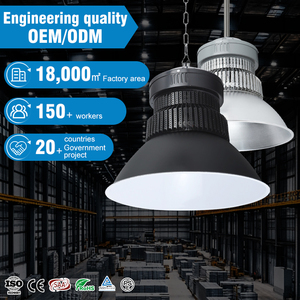
Combining decades of architectural and industrial lighting design heritage with advanced in-house manufacturing, our facility stands at the forefront of highbay fixture innovation. We bridge the gap between custom specifier requirements and scalable, cost-efficient mass production.
From tool engineering and aluminum spinning to precision CNC machining, powder coating, automated SMT, and wiring assembly—every step is executed under one roof for complete quality traceability.
Our engineering team delivers fully dimensioned shop drawings, CAD models, and photometrics (IES files) within 48 hours to streamline your project approval and tender submission timelines.
Equipped with Type-C Goniophotometers, 2-Meter Integrating Spheres, IPX6/IPX9K water chambers, ESD testers, and environmental thermal shock rooms ensuring absolute compliance with UL, CE, ETL, DLC, and RoHS.
Technical clarity and procurement insights for commercial buyers, distributors, and engineering contractors.
Partner directly with a lead-tier Chinese manufacturer. Request immediate IES photometrics, shop drawings, custom OEM branding options, or factory-direct volume price quotes today.