0%

Choosing the right Flush Mount Ceiling Fixtures can shape how a room feels, performs, and ages. Global buyers face more than a simple style decision. Voltage, socket design, ceiling structure, safety certifications, and shipping conditions all deserve attention.

This guide introduces ten practical fixtures for homes, hotels, offices, and light commercial spaces. Each option is considered through visible details, including diffuser clarity, metal thickness, lumen output, color temperature, and installation access. A warm 2700K model may soften a bedroom, while a 4000K fixture can improve task visibility in a corridor. Small differences matter.

We also examine supplier reliability, replacement parts, packaging quality, and documentation. Buyers should confirm regional electrical requirements before ordering. A product suitable for one market may need different wiring or certification elsewhere. That part is sometimes overlooked. It should not be.

Our perspective combines product research with practical installation concerns. We avoid judging fixtures by appearance alone. A beautiful canopy can still hide weak mounting hardware. An affordable light may become expensive after fragile shipping or unavailable components. These are not absolute rules, but they are useful warnings.

The ranking reflects balanced value, not one universal winner. Climate, room size, ceiling material, maintenance access, and purchasing volume can change the result. Some details remain difficult to verify from catalog images. That limitation deserves honesty.

Whether you need a compact hallway light or a durable commercial fitting, this selection offers a clearer starting point. Expect useful comparisons, realistic cautions, and details that support more confident global purchasing decisions.
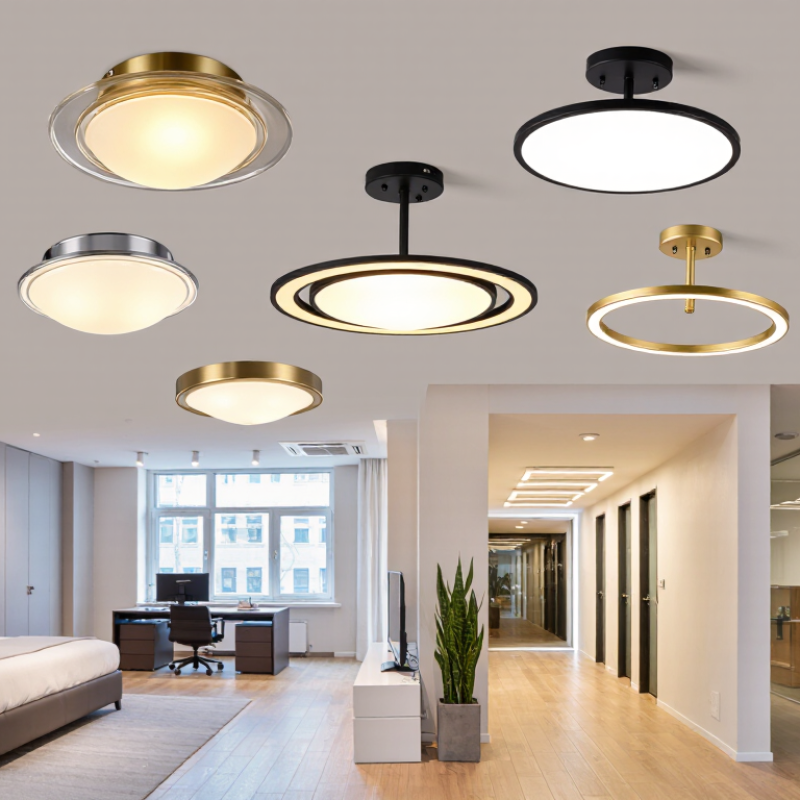
Top 10 Flush Mount Ceiling Fixtures for Global Buyers

Flush Mount Ceiling Fixtures: Definition, Structure, and Main Applications

Flush mount ceiling fixtures sit directly against the ceiling, leaving little or no gap above the fitting. Unlike pendant lights, they suit rooms with low ceilings and busy walkways. Simple appearance.

Their structure usually includes a mounting bracket, electrical box connection, housing, light source, diffuser, trim, and LED driver. The bracket supports the fixture and keeps it stable. The housing protects internal parts from dust and accidental contact. A diffuser softens glare and spreads light across the room. LED boards provide efficient illumination, while the driver controls current and supports safe operation. Heat management still matters. A thin housing may look attractive but can reduce driver life if ventilation is poor.

These fixtures work well in bedrooms, hallways, kitchens, offices, hotel rooms, and rental properties. Bathrooms require models with suitable moisture protection and careful installation. Not every sealed-looking fixture is suitable for wet areas. Buyers should check voltage, frequency, certifications, lumen output, color temperature, and color rendering performance for each market. Requirements differ by country.

Measure twice. Install once. During inspections, I often see ceiling boxes placed slightly off-center, making the trim appear uneven. A compatible bracket can reduce this problem. Buyers should also check diffuser replacement, cleaning access, and spare driver availability. A fixture may pass a showroom test yet disappoint in a dark corridor. Real applications expose weaknesses that product photos rarely show.

Key Features to Evaluate Before Choosing a Ceiling Fixture

Top 10 Flush Mount Ceiling Fixtures for Global Buyers

Key Features to Evaluate Before Choosing a Ceiling Fixture

A flush mount fixture should suit the room, ceiling, and electrical system. Measure twice. A low-profile design usually works well in bedrooms, hallways, and rooms with limited headroom. Check the fixture’s diameter against the ceiling box and nearby doors. A large shade can feel crowded in a narrow entryway.

Light quality deserves careful attention. Look for the right lumen output, color temperature, and color rendering index. Warm light near 2700K can create a relaxed bedroom atmosphere. Neutral light around 4000K may support kitchens or work areas. A high CRI helps fabrics and wall colors appear more natural. Dimmability is useful, but the fixture, dimmer, and driver must be compatible. They do not always cooperate.

Global buyers should verify voltage range, frequency, wiring instructions, and local safety certification. A model rated for 100–240V may simplify sourcing, but regional approval still matters. Check the IP rating for bathrooms, covered porches, or humid spaces. Review heat management too. Trapped heat can shorten LED life. During installation reviews, loose terminals and unclear instructions appear more often than expected. That is worth questioning. Confirm mounting hardware, replacement parts, warranty terms, and cleaning access before purchase. A beautiful fixture becomes frustrating when its shade is difficult to remove.

Top 10 Flush Mount Ceiling Fixtures for Global Buyers

Top 10 Flush Mount Ceiling Fixtures for Global Buyers

Choosing among the top 10 flush mount ceiling fixtures requires more than attractive photographs. I compare lumen output, beam spread, color rendering, driver quality, mounting depth, and service access. A compact bedroom may need 800–1,200 lumens, while a kitchen often needs 1,500 lumens or more.

For international projects, confirm voltage range, frequency, dimming compatibility, and applicable safety certification before ordering. Small details matter.

Energy performance deserves equal attention. The International Energy Agency’s 2023 Global Status Report for Buildings and Construction states that buildings consumed about 30% of global final energy in 2022. The U.S. Department of Energy reports that LED lighting uses at least 75% less energy and lasts up to 25 times longer than incandescent lighting.

Therefore, the strongest options usually include efficient LED modules, replaceable drivers, and thermal designs that reduce heat buildup.

Look for 2700K–3000K in bedrooms and 3500K–4000K in work areas. Choose CRI 90 or higher where accurate colors matter.

My practical shortlist includes:

slim LED panels
edge-lit discs
decorative opal domes
moisture-resistant bathroom fixtures
sensor-integrated models
emergency-compatible units
acoustic designs
smart dimmable fixtures
high-lumen commercial fixtures
low-glare residential models

Not every ranking survives real installation. Some fixtures look excellent but expose difficult wiring terminals or produce visible flicker. That is easy to miss.

Global buyers should request photometric files, warranty terms, spare-part availability, and installation instructions in advance. A slightly less fashionable fixture may perform better for ten years.

Installation, Maintenance, and Safety Considerations

Top 10 Flush Mount Ceiling Fixtures for Global Buyers

For global buyers, a flush-mount ceiling fixture is only as safe as its installation. Confirm local voltage, frequency, ceiling-box dimensions, and conformity requirements before ordering. IEC 60598-1 addresses protection against electric shock, heat, and mechanical hazards. Ask for test documentation, not only sales claims. A qualified electrician should isolate the circuit, verify dead wires, and secure the bracket to a rated junction box. Never hang a heavy fitting from plasterboard alone. Small mistake, serious consequence.

Energy performance affects long-term value. The U.S. Department of Energy reports that LED lighting uses at least 75% less energy and lasts up to 25 times longer than incandescent lighting. UNEP’s 2023 Global Status Report for Buildings and Construction states that buildings consume about 34% of global energy and create approximately 37% of energy-related emissions. Leave ventilation space around the driver, keep insulation clear when required, and match the dimmer to the fixture. I sometimes see this detail overlooked.

Maintenance should remain simple but disciplined. Switch off power before cleaning, use a dry microfiber cloth, and inspect loose screws, darkened terminals, buzzing, or flicker every six to twelve months. Do not spray cleaner into the diffuser. Replace damaged wiring immediately. IP ratings matter in bathrooms and covered outdoor areas. Choose them for actual moisture exposure, not appearance. “Maintenance-free” does not mean risk-free. Keep installation records and follow local electrical codes.

Top 10 Flush Mount Ceiling Fixtures for Global Buyers

Typical installation time and annual maintenance requirements for commonly specified flush-mount fixture types. Values are practical planning benchmarks; always confirm the product manual, local electrical code, ceiling structure, and environmental rating before installation.

Lower installation time generally indicates simpler wiring and lighter fixture construction. Maintenance time includes routine cleaning, visual inspection, diffuser checks, and functional testing. Fixtures installed in damp locations require an appropriate IP rating, while mains-powered products should be installed by qualified personnel with the circuit isolated.

Regional Standards, Compatibility, and International Purchasing Tips

Top 10 Flush Mount Ceiling Fixtures for Global Buyers

Choosing a flush mount ceiling fixture internationally requires more than comparing shape and price. Regional standards can change the entire installation process. Homes in North America often use 120V systems, while many markets use 220–240V. Frequency may also differ between 50Hz and 60Hz. Confirm the fixture’s rated voltage, frequency, and driver specifications before ordering. A beautiful fixture is useless if its electrical parts are incompatible.

Socket formats need careful checking. E26 and E27 look similar, but small dimensional differences may affect fit. Mounting plates, ceiling boxes, grounding wires, and screw spacing also vary by region. Certification requirements may include CE, UKCA, or other local approvals. Damp rooms need suitable ingress protection, not just a sealed-looking cover. Experienced buyers request technical drawings, wiring diagrams, test reports, and carton dimensions. One missing measurement can delay installation.

Tips: Ask the supplier for a sample or detailed photos before placing a bulk order. Confirm whether bulbs, drivers, mounting hardware, and instructions are included. Check customs documents, packaging strength, replacement-part access, and warranty terms. Compare the total landed cost, not only the unit price. Some listings appear complete, yet specifications remain unclear. That uncertainty deserves a second review. Even experienced purchasers can overlook ceiling-box compatibility when focusing on appearance.

Top 10 Flush Mount Ceiling Fixtures for Global Buyers - Regional Standards, Compatibility, and International Purchasing Tips
Rank Fixture Type Typical Size Typical Wattage / Light Output Input Voltage and Frequency Recommended Application Ingress Protection Ceiling and Wiring Compatibility Relevant Standards or Marks International Purchasing Tips
1 Slim Integrated LED Flush Mount 220–300 mm diameter
35–55 mm depth
12–18 W
Approximately 1,000–1,800 lm
100–240 V AC
50/60 Hz
Bedrooms, corridors, apartments, offices and general residential lighting IP20 Suitable for standard surface-mount ceiling boxes when the supplied bracket and screw spacing match. Requires a dedicated LED driver. IEC 60598-1; IEC 60598-2-1; regional conformity requirements such as CE, UKCA, UL/CSA or RCM may apply. Choose a wide-range input driver for mixed-voltage markets. Confirm terminal type, mounting-hole spacing and minimum ceiling-box depth before ordering.
2 Medium Round LED Ceiling Panel 300–400 mm diameter
40–65 mm depth
18–24 W
Approximately 1,500–2,400 lm
100–240 V AC
50/60 Hz
Living rooms, kitchens, hallways and small commercial spaces IP20 Surface-mounted over a junction box or directly to the ceiling using anchors. A grounded metal body may require protective earth. IEC 60598-1; IEC 60598-2-1; EMC and electrical-safety requirements vary by destination market. Request photometric files, LED color consistency data and driver certificates. A 3,000–4,000 K color temperature is commonly selected for general-purpose interiors.
3 Large High-Output Flush Mount 450–600 mm diameter
50–85 mm depth
24–40 W
Approximately 2,400–4,000 lm
100–240 V AC
50/60 Hz
Open-plan rooms, retail areas, classrooms and reception spaces IP20 Requires a secure ceiling structure and adequate junction-box support. Larger fixtures should be checked for total weight and bracket load capacity. IEC 60598-1; IEC 60598-2-1; local building and wiring rules may require independent support. Check glare rating, beam distribution and thermal management. Confirm that the mounting hardware is suitable for concrete, wood or suspended-ceiling construction.
4 Bathroom-Rated Flush Mount 250–400 mm diameter
45–75 mm depth
12–24 W
Approximately 1,000–2,400 lm
100–240 V AC
50/60 Hz
Bathrooms, laundry rooms and other areas with occasional moisture IP44 or higher Must be installed according to local bathroom-zone rules. The ceiling location, wiring method and protective device requirements differ by country. IEC 60598-1; IEC 60598-2-1; IP classification according to IEC 60529. IP44 does not mean the fixture is suitable for direct water jets or outdoor exposure. Verify the permitted installation zone and sealing of cable entries.
5 Replaceable-Lamp Flush Mount 250–450 mm diameter
80–140 mm depth
Typically one or more lamps
Common lamp ratings: 5–15 W LED per lamp
Fixture rating must match the local supply
Common systems: 120 V or 220–240 V AC
Residential rooms where lamp replacement and future maintenance are priorities IP20
Higher ratings available
Uses a standard lamp holder such as E27, E26, GU10 or another specified type. Lamp-base size and voltage must match the fixture and destination market. IEC 60598-1; lamp-holder requirements may reference IEC 60238, IEC 60400 or applicable regional equivalents. Do not assume E26 and E27 are interchangeable for every application. Specify the lamp holder, maximum lamp wattage, supply voltage and included lamp status.
6 Dimmable LED Flush Mount 300–500 mm diameter
45–80 mm depth
18–36 W
Approximately 1,500–3,600 lm
100–240 V AC
50/60 Hz
Dining rooms, hospitality interiors, meeting rooms and residential spaces requiring brightness control IP20 Requires a compatible dimmer, driver and wiring arrangement. Phase-cut, 0–10 V, DALI and other control methods are not automatically interchangeable. IEC 60598-1; IEC 62386 may apply to DALI systems; local EMC and dimmer requirements also apply. Specify the dimming protocol, dimming range, minimum load, flicker performance and compatible control equipment. Request a tested driver-and-dimmer combination.
7 Selectable-Color-Temperature LED Fixture 250–400 mm diameter
40–70 mm depth
15–30 W
Approximately 1,200–3,000 lm
100–240 V AC
50/60 Hz
Residential and commercial interiors needing warm, neutral or cool white settings IP20 Usually surface-mounted with an integrated driver and a color-selection switch or remote control. The control interface must remain accessible after installation. IEC 60598-1; IEC 62471 may be relevant for photobiological safety assessment; regional EMC rules apply. Confirm the selectable ranges, such as 2700 K/3000 K/4000 K/5000 K, and whether the selected setting is retained after power interruption.
8 Motion-Sensor Flush Mount 250–400 mm diameter
50–85 mm depth
12–24 W
Approximately 1,000–2,400 lm
100–240 V AC
50/60 Hz
Stairways, corridors, storage areas, entrances and shared residential spaces IP20
IP44 options
Requires a neutral and switched-line arrangement unless the product specifically supports another wiring method. Sensor coverage depends on mounting height and room layout. IEC 60598-1; applicable radio, EMC and electrical-safety requirements depend on whether the sensor uses wireless communication. Check detection angle, range, hold time, daylight threshold, standby power and false-trigger performance. Confirm sensor operation through the diffuser.
9 Emergency-Backup Flush Mount 300–500 mm diameter
55–100 mm depth
18–36 W normal operation
Emergency output and duration depend on battery system
Typically 100–240 V AC
50/60 Hz
Public buildings, hotels, offices, stairways and commercial premises requiring emergency illumination IP20–IP44 Needs permanent supply wiring, battery access and periodic testing. Some installations require a maintained or non-maintained emergency mode. IEC 60598-1; IEC 60598-2-22; emergency-lighting design and testing rules vary by jurisdiction. Specify emergency duration, commonly 1 or 3 hours where locally required, battery chemistry, recharge time, test method and emergency-lumen output.
10 Covered-Outdoor Flush Mount 250–450 mm diameter
60–110 mm depth
15–30 W
Approximately 1,200–3,000 lm
100–240 V AC
50/60 Hz
Covered porches, entryways, balconies and sheltered exterior ceilings IP54 or higher Requires weather-resistant cable entry, suitable gaskets and corrosion-resistant mounting hardware. Direct exposure limits must be confirmed separately. IEC 60598-1; IEC 60598-2-1; IP classification according to IEC 60529; regional outdoor-installation rules may apply. IP54 is not automatically suitable for driving rain, immersion or coastal corrosion. Confirm UV resistance, operating temperature and material durability.
Purchasing note: Supply voltage, plug or terminal configuration, grounding method, dimming compatibility, IP rating and certification requirements must be verified against the destination country’s electrical code before shipment. Product specifications and conformity documentation should be requested for the exact model and production revision.

FAQS

What is a flush mount ceiling fixture?

It sits directly against the ceiling, leaving little or no gap. It suits low ceilings and busy walkways. Simple and space-saving.

What parts does a flush mount fixture usually include?

Common parts include a mounting bracket, housing, diffuser, trim, light source, and LED driver. The bracket provides support. The diffuser reduces glare and spreads light evenly.

Where are these fixtures commonly used?

They work well in bedrooms, hallways, kitchens, offices, hotels, and rental properties. Their compact shape reduces collision risks in narrow passages. A dark corridor may still need stronger output.

What should buyers check before ordering?

Check voltage, frequency, certifications, lumen output, color temperature, and color rendering. Confirm the ceiling-box dimensions too. Requirements differ by country.

Are flush mount fixtures suitable for bathrooms?

Some are suitable, but moisture protection must match the installation area. A sealed appearance proves little. Check the actual IP rating and local electrical requirements.

How should a flush mount fixture be installed safely?

A qualified electrician should isolate the circuit and verify that wires are dead. Secure the bracket to a rated junction box. Never support a heavy fitting with plasterboard alone.

How can buyers avoid an uneven installation?

Measure the ceiling box and fixture position carefully before drilling. An off-center box can make the trim look visibly crooked. Measure twice.

How does LED lighting affect long-term value?

LED lighting generally uses much less energy and lasts longer than incandescent lighting. Good heat management protects the driver and extends service life. Thin housings may restrict ventilation.

How should these fixtures be cleaned and inspected?

Switch off power before cleaning. Use a dry microfiber cloth on the diffuser and trim. Do not spray cleaner inside. Every six to twelve months, check screws, terminals, buzzing, flicker, and dark marks. I sometimes underestimate these small warning signs.

Conclusion

Flush Mount Ceiling Fixtures are compact lighting solutions installed directly against the ceiling, making them suitable for rooms with limited headroom and a clean, unobtrusive appearance. This article explains their basic structure, including the mounting base, light source, diffuser, and housing, as well as common applications in homes, offices, hotels, retail spaces, and public facilities. It also outlines key factors buyers should evaluate, such as brightness, color temperature, energy efficiency, material quality, dimensions, dimming functions, durability, and ease of installation.

The guide presents ten practical fixture options for global buyers, covering different designs, performance levels, and application needs. It further discusses installation procedures, routine cleaning, heat management, and electrical safety. To support international purchasing, the article highlights regional voltage differences, socket and wiring compatibility, certification expectations, packaging, shipping considerations, warranty terms, and communication with suppliers. These recommendations help buyers select reliable ceiling lighting while reducing compatibility issues and ensuring safe, efficient use in different markets.


Oliver

Oliver

Oliver is a highly experienced marketing professional dedicated to helping businesses understand products, markets, and customer needs more clearly. With a strong background in product strategy, content development, and digital communication, he brings both analytical insight and practical......