Custom Globe Pendant Lights are becoming a practical design choice for hotels, restaurants, retail spaces, and refined homes. Their rounded glass forms soften hard interiors, while adjustable finishes create a clear visual identity. A smoked globe above a marble counter feels quiet and luxurious. A cluster of opal globes can make a dining table feel warmer.
Market evidence supports this wider interest in decorative lighting. Fortune Business Insights valued the global lighting market at approximately USD 128.48 billion in 2023. It projects the market to reach about USD 208.02 billion by 2032. Grand View Research also identifies energy efficiency, smart controls, and design customization as important lighting trends. These reports do not isolate Custom Globe Pendant Lights. That limitation matters.
Details matter more than fashion.
Lighting designer and author Randall Whitehead has described lighting as “the jewelry of architecture.” His view explains why pendant selection involves more than appearance. Globe diameter, canopy size, suspension length, color temperature, and glare control affect everyday comfort. A beautiful fixture can still disappoint when it hangs too low or exposes a harsh bulb.
This guide examines ten Custom Globe Pendant Lights for global buyers. It considers material quality, installation flexibility, visual balance, maintenance, and supplier reliability. We also look at practical buying signals, including sample approval, electrical compatibility, packaging protection, and documented product specifications. Some choices may look perfect online but feel oversized in a real room. That is an easy mistake to make. A better decision begins with measurements, intended use, and honest attention to how people experience light.
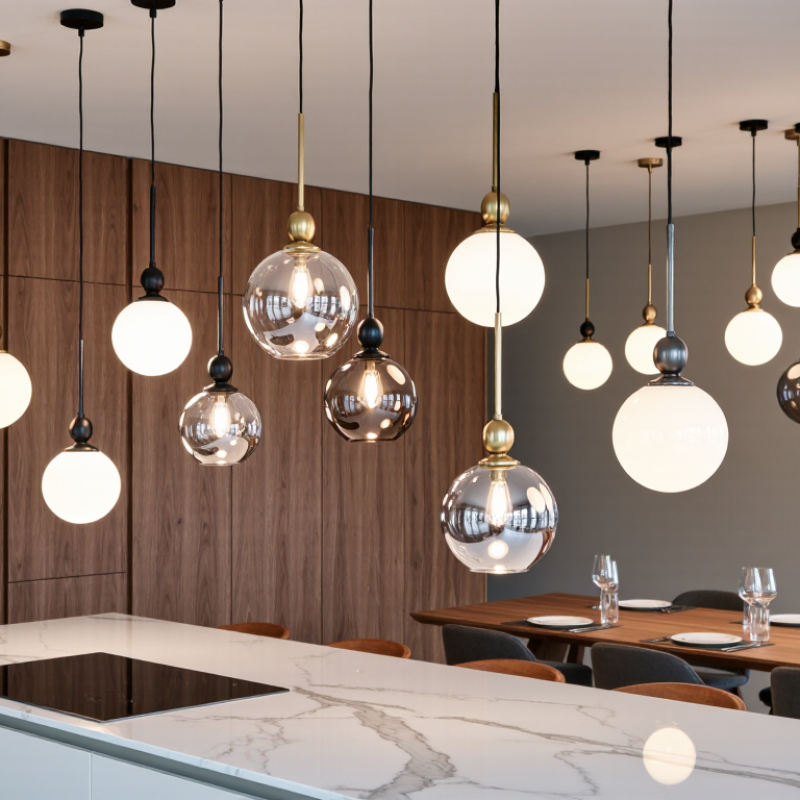
Top 10 Custom Globe Pendant Lights: Ranking Scope and Buyer Criteria
This ranking covers custom globe pendant lights for homes, hotels, restaurants, and commercial interiors. Each option must offer meaningful customization, not only a different cord color. I assess globe diameter, glass finish, drop length, canopy size, lamp compatibility, and ceiling suitability. Opal glass creates soft light over a dining table. Clear glass produces sharper shadows. Smoked glass looks dramatic, but it may reduce brightness.
The scoring gives 25% to light quality and 20% to material and construction. Custom flexibility receives another 20%. Installation clarity, wiring information, and regional electrical documentation account for 15%. Packaging, replacement parts, lead time, and value make up the remaining 20%. These criteria reflect practical buying experience, especially when fixtures travel across borders. Buyers should request dimensional drawings before ordering. A beautiful 30-centimeter globe can feel undersized above a large table.
Details matter.
I also check socket type, dimming support, cable adjustability, and heat management. Qualified electricians should confirm local installation requirements. Product pages often promise easy installation, yet ceiling structure can complicate the work. That weakness deserves attention. A ranking cannot fully measure color accuracy, hand-finished surfaces, or damage during shipping. Sample photos may also differ from real glass under warm bulbs. Buyers should request close-up images, packing details, warranty terms, and a written replacement process. The strongest custom pendant combines visual balance, dependable documentation, and realistic after-sales support.
A comparative buying table focused on customization flexibility, international electrical compatibility, shipping practicality, safety requirements, and typical wholesale suitability.
| Rank | Custom Globe Pendant Concept | Globe Size | Primary Materials | Light Source and Socket | Typical Electrical Options | Customization Scope | Target Certification Support | Typical Wholesale MOQ | Indicative FOB Range | Estimated Production Lead Time | Buyer-Fit Score |
|---|---|---|---|---|---|---|---|---|---|---|---|
| 1 |
Opal Glass Globe Pendant
Best all-rounder
|
200–400 mm diameter | Blown or molded opal glass; powder-coated metal canopy | Replaceable LED bulb; E26/E27 or G9 socket | 110–120 V, 220–240 V; 50/60 Hz | Glass diameter, canopy finish, cord length, socket type, dimmable configuration | CE, UKCA, ETL/UL, or SAA options subject to final design and testing | 20–50 units | US$45–110 per unit | 5–8 weeks | 94/100 |
| 2 |
Ribbed Glass Globe Pendant
Decorative texture
|
180–350 mm diameter | Ribbed clear, smoke, or opal glass; steel hardware | Replaceable LED bulb; E26/E27 socket | 110–120 V or 220–240 V; dimmable driver optional | Rib pattern, glass tint, metal finish, suspension length, ceiling plate shape | CE, UKCA, ETL/UL, or SAA options depending on market | 20–50 units | US$48–125 per unit | 6–9 weeks | 92/100 |
| 3 |
Handcrafted Clear Glass Globe Pendant
Premium appearance
|
220–450 mm diameter | Hand-blown clear glass; brass, aluminum, or steel fittings | Replaceable LED bulb; E26/E27 socket | 110–120 V or 220–240 V; 50/60 Hz | Bubble density, glass thickness, tint, metal plating, cable and canopy dimensions | Market-specific certification package available after sample approval | 10–30 units | US$70–180 per unit | 7–10 weeks | 90/100 |
| 4 |
Matte Metal Globe Pendant
Commercial durability
|
250–500 mm diameter | Spun or stamped steel; powder-coated or plated finish | Replaceable LED bulb; E26/E27 socket | 110–120 V or 220–240 V; dimmable bulb compatible | Color matching, perforation pattern, globe diameter, canopy, cable length | CE, UKCA, ETL/UL, or SAA support based on wiring configuration | 30–100 units | US$32–85 per unit | 4–7 weeks | 88/100 |
| 5 |
Globe Pendant with Integrated LED Ring
Energy-efficient
|
250–600 mm diameter | Aluminum frame, acrylic diffuser, steel canopy | Integrated LED module; non-replaceable light source | 110–120 V or 220–240 V; 2700–4000 K; dimmable option | Wattage, color temperature, CRI, diffuser finish, suspension height, driver placement | CE, UKCA, ETL/UL, SAA, and EMC testing may be specified by destination | 20–50 units | US$65–160 per unit | 6–10 weeks | 87/100 |
| 6 |
Woven Rattan Globe Pendant
Natural-material style
|
300–600 mm diameter | Rattan or bamboo veneer with metal frame and canopy | Replaceable LED bulb; E26/E27 socket | 110–120 V or 220–240 V; low-heat LED bulb recommended | Weave density, natural stain, globe size, inner diffuser, cord and canopy finish | Electrical certification depends on the finished wiring assembly and material treatment | 30–100 units | US$38–105 per unit | 6–9 weeks | 84/100 |
| 7 |
Clustered Globe Pendant System
Hospitality and residential
|
Three to twelve globes; 150–350 mm each | Glass or acrylic globes; metal ceiling canopy | Replaceable LED bulbs; E26/E27, G9, or integrated LED | 110–120 V or 220–240 V; multi-circuit option available | Number of globes, drop heights, canopy shape, globe mix, finish, dimming method | Certification must cover the complete multi-light assembly and driver configuration | 10–30 systems | US$120–420 per system | 7–11 weeks | 83/100 |
| 8 |
Frosted Acrylic Globe Pendant
Lightweight shipping
|
200–500 mm diameter | Frosted acrylic or polycarbonate diffuser; aluminum or steel frame | Integrated LED or replaceable LED bulb | 110–120 V or 220–240 V; 2700–5000 K options | Diffuser opacity, color temperature, wattage, diameter, cable length, canopy finish | CE, UKCA, ETL/UL, or SAA options subject to final electrical construction | 50–200 units | US$28–90 per unit | 4–8 weeks | 81/100 |
| 9 |
Outdoor-Rated Globe Pendant
Covered outdoor use
|
200–450 mm diameter | UV-resistant polycarbonate or treated glass; corrosion-resistant metal | Replaceable LED bulb or sealed LED module | 110–120 V or 220–240 V; IP44–IP65 design target | IP rating, cable jacket, drainage design, mounting hardware, color, globe size | Outdoor safety and ingress-protection testing required for the stated rating | 30–100 units | US$55–150 per unit | 7–12 weeks | 79/100 |
| 10 |
Large Statement Globe Pendant
Architectural focal point
|
600–1200 mm diameter | Lightweight acrylic, fiberglass, aluminum, or reinforced glass | Integrated LED or multiple replaceable LED bulbs | 110–120 V or 220–240 V; remote-driver option available | Oversized diameter, internal frame, light distribution, suspension system, custom color | Certification and structural review should be specified for the installation market | 5–20 units | US$180–650 per unit | 8–14 weeks | 77/100 |
Useful options include globe diameter, glass finish, drop length, canopy size, and socket type. Different cord colors alone are not enough. Details matter.
Measure the table and ceiling before ordering. A 30-centimeter globe may look small above a wide table. Request a dimension drawing. Visual balance can be difficult to judge online.
Opal glass spreads soft light across a table. Clear glass creates sharper shadows. Smoked glass feels dramatic but may reduce brightness. Warm bulbs can also change the glass appearance. Photos are imperfect.
Ask for fixture-level wattage, delivered lumens, color temperature, color rendering, and power factor. A complete pendant may perform below its LED component. That gap matters.
Efficient LED components may exceed 150 lumens per watt in testing. The complete fixture usually delivers less. For example, 800 lumens from 8 watts equals 100 lumens per watt. Use real fixture data.
It can. A warm 2700K globe may be less efficient than a cooler 4000K version. High color rendering may also reduce efficiency slightly. Comfort matters too. Maximum efficiency is not always the best room experience.
Confirm ceiling structure, wiring details, canopy space, and local electrical requirements. A qualified electrician should review the installation. “Easy installation” may not fit every ceiling. That weakness deserves attention.
Yes. Poor drivers may flicker, waste power, or shorten service life. Thick glass and enclosed canopies can also increase heat. Ask about compatible controls and replacement drivers. Small parts matter.
Request packing photos, replacement procedures, warranty terms, and spare-part availability. Glass can arrive damaged after long-distance transport. Promises are not proof. A written process is safer.
This guide ranks the Top 10 Custom Globe Pendant Lights for global buyers by combining design flexibility, lighting performance, safety, durability, and commercial value. It explains how to assess globe pendant fixtures under IEC 60598-1 and how IP protection ratings affect suitability for dry, damp, or demanding environments. Buyers will also learn how lumen output, color rendering index (CRI), and correlated color temperature (CCT) influence brightness, color accuracy, and atmosphere, using practical principles aligned with IES lighting guidance.
The article further compares energy performance through LED efficiency benchmarks published by the U.S. Department of Energy, helping purchasers balance operating costs with visual quality. It also highlights customization options such as dimensions, finishes, suspension systems, light distribution, and control compatibility. For international sourcing, the guide emphasizes documentation, electrical compatibility, quality inspection, packaging, installation requirements, and safety compliance, enabling designers, contractors, hospitality projects, and commercial buyers to select Custom Globe Pendant Lights with confidence.