Choosing the best ADA Compliant Wall Sconces requires more than comparing finishes, prices, or lumen ratings. Placement matters. Mounting height matters. Glare matters even more in a narrow hallway.
The 2010 ADA Standards for Accessible Design limit protruding objects to four inches from walls when installed between 27 and 80 inches above the finished floor. The standards also specify accessible reach ranges for related switches and controls. These details can eliminate an attractive fixture from an otherwise compliant plan. The CDC’s Disability and Health Data System reports that about one in four U.S. adults has a disability. That figure makes inclusive lighting a practical design responsibility, not a decorative trend.
Ronald Mace, an accessibility design pioneer and founder of the Center for Universal Design, wrote, “Universal design is the design of products and environments to be usable by all people, to the greatest extent possible.” His principle remains useful when evaluating wall lighting. The U.S. Department of Energy’s solid-state lighting research reports also emphasize LED efficiency, controllability, and improved visual performance. Those benefits can support safer, more comfortable spaces when properly specified.
This guide compares ten leading ADA Compliant Wall Sconces through practical criteria: projection, mounting flexibility, light distribution, color temperature, glare control, durability, and installation clarity. Some products look compliant in photographs but require careful field measurements. That is where selection becomes less certain. A ranking cannot replace the project’s approved drawings, local review, or a qualified electrician’s verification. Still, the comparison offers a realistic starting point for corridors, bathrooms, bedrooms, hospitality spaces, and public interiors.
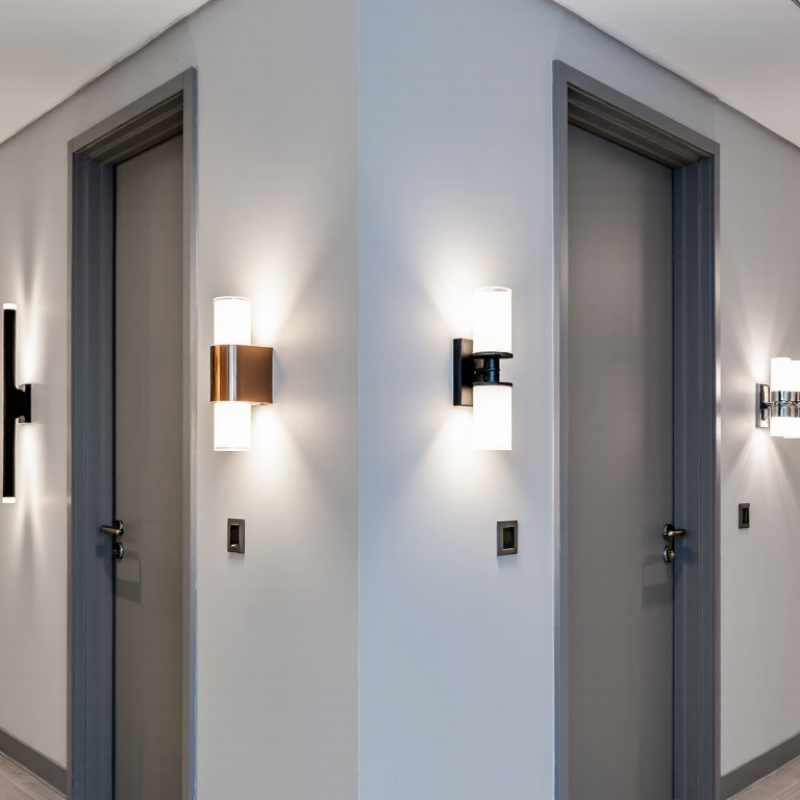
ADA Wall Sconce Standards: The 4-Inch Projection Limit Under ADA 307.2
Choosing the top 10 ADA compliant wall sconces requires more than comparing finishes or brightness. Their projection matters most in accessible circulation paths. Under ADA 307.2, objects with leading edges between 27 and 80 inches above the finished floor may project no more than 4 inches from the wall.
Measure the fixture’s furthest point, not its backplate. Include the shade, lamp housing, arm, and any adjustable component. A sconce mounted at 68 inches may appear compact, yet a wide fabric shade can exceed the limit. A small difference matters. Use a tape measure on the installed fixture, not only the product drawing.
Mounting height also deserves careful review. Fixtures placed above 80 inches are outside this specific protrusion range, but they still need appropriate clearance and safe installation. Wall sconces beside corridors, accessible routes, and door approaches require extra attention. A nearby handrail, sign, or corner can change the usable path.
A practical review should record projection, mounting height, corridor width, and nearby obstructions. Photographs help verify field conditions. Product specifications are useful, but they are not perfect substitutes for site measurements. An installation can look compliant in a rendering and fail after the shade is fitted. Local authorities may apply additional requirements, so designers should confirm the final arrangement with the project’s accessibility professional or code official.
How to Evaluate the Top 10 ADA-Compliant Wall Sconces by Safety and Design
Evaluating the top 10 ADA-compliant wall sconces requires more than checking appearance. I would begin with projection, mounting height, and the fixture’s position along an accessible route. A wall sconce should not extend more than four inches into a circulation path where protruding-object rules apply. Its lower edge should also avoid creating a collision hazard. Measure the installed fixture, not only the product drawing. Small installation changes matter.
Safety comes before decoration. Look for rounded edges, enclosed bulbs, stable mounting plates, and finishes that remain cool during normal use. Choose diffused light to reduce glare near mirrors, corridors, and bedside areas. Controls should be reachable without stretching or blocking the route. For each of the ten sconces, I would inspect its accessibility documentation, electrical rating, and suitability for damp locations. “ADA compliant” should not be accepted as an unsupported label. Local building requirements may differ.
Design still deserves careful review. Compare the ten fixtures by beam direction, visual contrast, scale, and cleaning access. A slim profile may suit a narrow hallway, while an adjustable shade can improve reading light. Test the fixture at eye level. Is the light comfortable, or does it expose a sharp glare? I have found that attractive fixtures sometimes fail after installation because the junction box sits too close to trim. That detail is easy to miss. A thoughtful evaluation records both the strengths and the compromises of each sconce.
What Are the Top 10 ADA Compliant Wall Sconces? - How to Evaluate the Top 10 ADA-Compliant Wall Sconces by Safety and Design
Top 10 ADA-Compliant Wall Sconce Configurations Evaluated by Safety, Accessibility, Performance, and Design
| Rank |
Sconce Configuration |
Maximum Projection |
Recommended Mounting Zone |
Light Output |
Color Quality |
Ingress Protection |
Glare Control |
ADA Projection Check |
Design and Safety Assessment |
Overall Score |
| 1 |
Low-Profile Opal Cylinder
Wall-mounted cylindrical shade with fully diffused light |
3.25 in |
Bottom at 32–36 in AFF |
800–1,000 lm |
90+ CRI
2700–3000 K |
IP44 |
Excellent; frosted diffuser |
Passes ≤4 in limit |
Excellent corridor safety, soft facial illumination, and minimal visual clutter. |
9.5/10 |
| 2 |
Shielded Up-and-Down Sconce
Compact linear fixture with concealed light sources |
3.75 in |
Bottom at 36–42 in AFF |
900–1,200 lm |
90+ CRI
3000 K |
IP44 |
Very good; top and bottom shields |
Passes ≤4 in limit |
Provides useful vertical light while reducing direct glare in circulation areas. |
9.2/10 |
| 3 |
Recessed-Backplate LED Sconce
Shallow rectangular fixture integrated into a slim backplate |
2.75 in |
Bottom at 30–36 in AFF |
700–900 lm |
90+ CRI
2700–3500 K |
IP44 |
Excellent; recessed lens |
Passes ≤4 in limit |
One of the safest choices for narrow corridors because it offers the smallest projection. |
9.1/10 |
| 4 |
Shielded Picture-Style Sconce
Horizontal fixture with a narrow opaque front shield |
3.50 in |
Bottom at 40–48 in AFF |
600–850 lm |
90+ CRI
3000 K |
IP20; dry interior use |
Very good; opaque front shield |
Passes ≤4 in limit |
Suitable for artwork, room entries, and hospitality interiors where controlled light is needed. |
8.8/10 |
| 5 |
Compact Drum Sconce
Shallow round shade with diffused front and side illumination |
3.90 in |
Bottom at 36–42 in AFF |
750–1,000 lm |
90+ CRI
2700–3000 K |
IP44 |
Good; diffused shade |
Passes ≤4 in limit |
Balanced decorative appearance with adequate protection for many residential and commercial interiors. |
8.7/10 |
| 6 |
Vertical Tubular Sconce
Thin vertical diffuser with a compact metal housing |
3.50 in |
Bottom at 38–44 in AFF |
800–1,100 lm |
90+ CRI
3000–3500 K |
IP44 |
Good; vertical diffuser |
Passes ≤4 in limit |
Good for elevators, corridors, and vanity zones; confirm that end caps do not create sharp edges. |
8.5/10 |
| 7 |
Indirect Wall-Wash Sconce
Light directed upward or downward against the wall |
3.80 in |
Bottom at 42–48 in AFF |
600–900 lm |
80–90 CRI
2700–3000 K |
IP20; dry interior use |
Excellent; indirect illumination |
Passes ≤4 in limit |
Minimizes eye-level glare and creates attractive ambient light, but may provide less task illumination. |
8.4/10 |
| 8 |
Vandal-Resistant Polycarbonate Sconce
Sealed, impact-resistant fixture for demanding locations |
3.60 in |
Bottom at 36–48 in AFF |
900–1,300 lm |
80+ CRI
3000–4000 K |
IP65 |
Good; sealed lens |
Passes ≤4 in limit |
Strong choice for public, damp, or high-use areas; utilitarian styling lowers its design score. |
8.3/10 |
| 9 |
Decorative Cage Sconce with Flush Diffuser
Open metal visual detail surrounding a protected light source |
3.95 in |
Bottom at 42–48 in AFF |
700–900 lm |
90+ CRI
2700–3000 K |
IP44 |
Moderate; verify exposed elements |
Passes ≤4 in limit |
Adds visual character, but the cage must be securely fixed and free of sharp or snagging projections. |
8.0/10 |
| 10 |
Adjustable Reading Sconce with Folded Arm
Directional fixture with a short, controlled swing arm |
4.00 in maximum |
Bottom at 48 in AFF or higher |
500–750 lm |
90+ CRI
2700–3000 K |
IP20; dry interior use |
Good; adjustable shade |
Passes when fully retracted |
Useful beside beds or seating, but the arm must remain within the projection limit in circulation zones. |
7.8/10 |
Evaluation note: Under ADA Standards for Accessible Design, objects mounted with their leading edge between 27 and 80 inches above the finished floor generally must not project more than 4 inches into an accessible circulation path. The projection results above apply only to the stated dimensions and mounting conditions. Confirm the complete fixture, mounting hardware, local building codes, electrical requirements, and accessibility clearances before installation.
Mounting Height: Applying the ADA’s 27–80-Inch Protruding-Object Zone
For ADA-compliant wall sconces, mounting height is more than a design decision. It affects how safely people move through corridors, ramps, and accessible rooms. The ADA’s protruding-object rule covers objects with leading edges between 27 and 80 inches above the finished floor. Within this zone, a wall-mounted fixture generally cannot extend more than 4 inches into the circulation path.
Measure from the wall surface to the fixture’s farthest point. Include the shade, arm, trim, and any adjustable component. A sconce may look compact on a drawing but become hazardous when its arm reaches into shoulder space. Keep the fixture outside the path when possible. This approach offers better protection for people using canes, wheelchairs, or limited peripheral vision.
Mounting the center of the fixture at 60 inches is not automatically compliant. The lowest and widest parts matter more. A lower edge below 27 inches follows different protruding-object rules, but it can still create a collision risk. Fixtures above 80 inches may avoid this specific zone, yet glare and maintenance remain important concerns. Check the completed installation, not only the shop drawings. A tape measure and a careful walk-through can reveal mistakes. Local building officials may apply additional requirements. That detail is easy to overlook.
Top 10 ADA-Compliant Wall Sconces Compared by Lumens, Glare, and Efficiency
What are the top 10 ADA-compliant wall sconces? A practical comparison should examine more than appearance.
The leading ten options include a shielded LED cylinder, recessed LED bar, frosted globe, slim up-and-down sconce, louvered rectangle, indirect wall washer, compact reading light, square diffuser, narrow vertical panel, and sealed wet-location fixture. Their output commonly ranges from 600 to 1,600 lumens. Efficiency usually falls between 80 and 120 lumens per watt. Numbers vary by test method.
Glare separates a comfortable fixture from a tiring one. The frosted globe and indirect wall washer usually soften bright points, while exposed LEDs can create sharp reflections on polished floors. A deep louver may control glare well, but it can reduce useful light. In corridors, 800 to 1,000 lumens often provides balanced visibility. Larger public rooms may need 1,200 lumens or more. Warm white light near 3000K feels calm, while 4000K can reveal surface details more clearly. Very bright is not always better.
For accessible routes, check the fixture’s actual projection, mounting height, and nearby obstructions. In the United States, wall-mounted objects generally cannot project more than four inches into an accessible route. Installation conditions still matter. A compliant housing may become problematic when mounted beside a door or handrail. Field measurements are more reliable than product photos. I have found that glare ratings alone can mislead; wall color, ceiling height, and viewer position change the experience. The best choice balances measured lumens, controlled glare, efficient operation, and safe clearance.
Choosing ADA Wall Sconces by Accessibility, Installation, and Building-Code Fit
What Are the Top 10 ADA Compliant Wall Sconces?
Choosing the top ten ADA wall sconces requires more than checking a product label. The U.S. Access Board’s 2010 ADA Standards limit wall-mounted objects to a 4-inch projection when installed between 27 and 80 inches above the finished floor. A slim, shielded fixture can protect shoulders and mobility devices along narrow corridors. Its installation height still matters.
Look for sealed LED housings, diffused lenses, accessible controls, and low-glare optics. Controls should generally sit between 15 and 48 inches when reachable from an accessible approach. The U.S. Department of Energy’s 2020 U.S. Lighting Market Characterization reported that LEDs represented 48% of installed lamps. That supports efficient choices, but efficiency does not prove accessibility. Color quality, heat, flicker, and maintenance access deserve equal attention. A fixture may appear compliant and still fail after careless mounting.
Tips:
Measure the finished wall, not the drawing. Check the sconce’s deepest point, nearby door swings, and corridor clearance. Confirm local code requirements with a qualified design professional. Federal ADA rules may not be the only standard governing the project. In field reviews, the weak point is often installation rather than the luminaire itself. I would also test glare at eye level; attractive light can become uncomfortable light. A small mistake here can affect daily use.
Conclusion
This guide reviews the Top 10 ADA Compliant Wall Sconces with a focus on safety, usability, and adaptable design. It explains the ADA 307.2 requirement that wall-mounted objects generally project no more than 4 inches into accessible routes, helping prevent collisions and maintain clear circulation. It also discusses the 27–80-inch protruding-object zone, emphasizing how proper mounting height can improve accessibility for people using mobility devices or navigating with limited vision.
Each sconce is evaluated through practical criteria, including light output, glare control, energy efficiency, visual comfort, and suitability for different interior settings. The guide also considers installation requirements, fixture placement, maintenance, and compatibility with applicable building codes. By comparing these factors together, readers can identify ADA Compliant Wall Sconces that provide effective illumination while supporting safe movement, comfortable visibility, and dependable long-term performance in residential, hospitality, commercial, and public spaces.