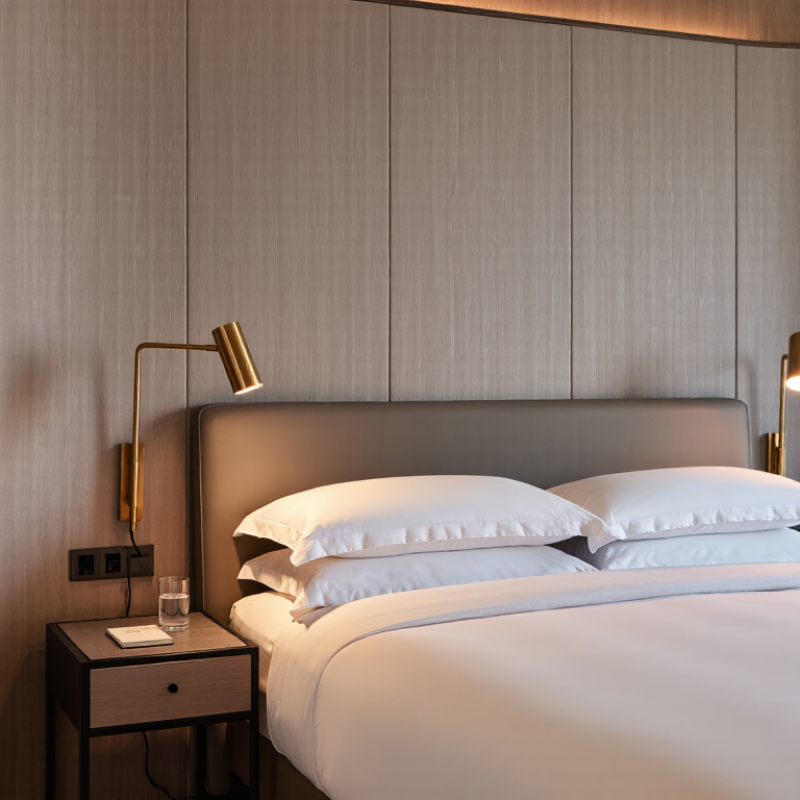
Choosing Custom Wall Sconces for a global project involves more than selecting a shape or finish. Each fixture must suit its setting, support the lighting plan, and fit the practical needs of installation and maintenance. A slim brass sconce beside a hotel bed may look refined, while a damp corridor or narrow passage may call for a different material, beam angle, and mounting position. Small details matter.
Start with the project brief. Confirm the required light output, color temperature, dimming method, mounting height, and finish before approving a sample. Ask the manufacturer for dimensioned drawings, material specifications, and test documentation relevant to the project. These records help designers, buyers, and local project teams review the same details. Still, specifications alone cannot show how a fixture feels in a real room. A mock-up beside the intended wall finish can reveal glare, shadow patterns, and unexpected color shifts.
Global sourcing adds coordination challenges. Electrical systems, installation practices, packaging needs, and service access can vary between project locations. Confirm requirements with qualified local professionals, and do not assume one version will suit every site. Discuss lead times, replacement parts, quality checks, and finish consistency with the supplier before production. A polished sample is only a starting point. Even careful planning can miss something; that is worth acknowledging. A practical selection process leaves room for review, clear communication, and adjustments before the sconces reach the site.
Choosing custom wall sconces for global projects begins with the correct compliance framework. IEC 60598-1 covers general luminaire safety, including insulation, wiring, temperature, mechanical strength, and testing methods. UL 1598 addresses fixed electric luminaires for applicable North American installations. They are not interchangeable standards. A project team should confirm the destination market before approving drawings, not after production starts.
IP ratings require equal attention. IP44 protects against solid objects over 1 mm and water splashes from all directions. IP65 adds dust-tight protection and resistance to low-pressure water jets. However, IP65 does not automatically prove resistance to salt air, condensation, chemicals, or prolonged outdoor exposure. Gaskets, cable entries, drainage paths, and surface finishes can change the real result. Small details matter.
Ask for current test reports, wiring diagrams, rated voltage, frequency, installation instructions, and material specifications. Check whether the complete custom configuration was tested, rather than a similar-looking model. A modified backplate or deeper shade can affect heat dissipation and ingress protection. I have found that simple visual checks often miss these changes. Compliance documents can also be incomplete. That is uncomfortable, but it deserves a second review. Involving a qualified local electrician or certification professional helps confirm installation requirements, especially when projects cross regions with different approval procedures.
| Decision Area | Standard or Rating | What It Covers | Typical Project Consideration | What to Verify for a Custom Wall Sconce |
|---|---|---|---|---|
| International luminaire safety | IEC 60598-1 | General safety requirements and tests for luminaires, including electrical, thermal, mechanical, and construction-related provisions. | Often used as the general luminaire standard for projects targeting markets that use IEC-based requirements. | Confirm the applicable edition, national deviations, and the relevant IEC 60598-2 particular standard for the luminaire type and installation. |
| North American luminaire safety | UL 1598 | Safety requirements for luminaires intended for use in accordance with applicable North American electrical codes. | May be relevant to fixed wall-mounted luminaires supplied to the United States or other markets that recognize this standard. | Confirm that the complete luminaire configuration—including driver, wiring, mounting method, and materials—is evaluated for the intended market. A standard alone is not a product certification. |
| Protection against solid objects and water | IP44 | The first digit, 4, indicates protection against solid objects 1 mm or larger. The second digit, 4, indicates protection against splashing water from any direction under the specified test conditions. | May suit some sheltered outdoor or damp-location installations when the project specification and local rules allow it. | Check the tested product configuration, including seals, cable entries, mounting orientation, and any required installation conditions. |
| Protection against dust and water jets | IP65 | The first digit, 6, indicates a dust-tight enclosure. The second digit, 5, indicates protection against water jets under the specified test conditions. | May be considered for more exposed locations where dust or water jets are foreseeable, subject to the site conditions and project requirements. | Verify that the rating applies to the complete assembled luminaire and its installed cable entries—not just an individual component. |
| Market access and approval | Applicable national or regional requirements | Local rules may adopt standards with amendments, require specific conformity procedures, or require approval by a recognized certification body or authority. | A product evaluated to one standard is not automatically accepted in every country or region. | Identify destination markets early and confirm required reports, markings, documentation, and accepted certification routes with the project authority or local compliance specialist. |
| Installation environment | IP rating plus project conditions | IP ratings address defined ingress tests; they do not, by themselves, establish corrosion resistance, impact resistance, UV resistance, or suitability for every outdoor condition. | Coastal, industrial, high-impact, or direct-weather locations may need additional material, finish, or mechanical requirements. | Specify exposure, mounting surface, orientation, cleaning method, and any separate corrosion or impact requirements in addition to the IP rating. |
| Custom design changes | Product configuration and test evidence | Changes to enclosure geometry, seals, materials, LED drivers, wiring, or mounting hardware can affect safety and ingress performance. | A previously tested design may not represent a customized version or a different assembly configuration. | Request documentation covering the exact proposed model and configuration; assess whether design changes require additional evaluation or testing. |
Confirm the destination market first. Different regions require different safety standards, testing methods, and installation approvals. Check before production.
No. IEC 60598-1 covers general luminaire safety, while UL 1598 applies to certain fixed installations in North America. They serve different frameworks.
IP44 protects against solid objects larger than one millimeter and water splashes from all directions. It is not dust-tight.
IP65 provides dust-tight protection and resistance to low-pressure water jets. It does not prove resistance to salt air or chemicals. Outdoor exposure still needs review.
Request current test reports, wiring diagrams, rated voltage, frequency, installation instructions, and material specifications. Ask for complete configuration evidence.
A deeper shade or modified backplate can change heat dissipation and water protection. Similar appearance proves very little. Visual checks can miss problems.
Consider marine-grade stainless steel, treated aluminum, or sealed engineering polymers. Use documented UV-stable coatings on sun-facing façades. Salt reaches tiny seams.
Use water-resistant gaskets, compatible fasteners, clear drainage paths, and a slight housing slope. Do not seal every gap automatically. Trapped moisture can damage drivers.
Temperature, operating current, heat-path design, and driver quality all affect service life. Published conditions matter more than the headline number. The rating is not guaranteed everywhere.
Leave access for driver replacement and inspect joints after installation. Stable color and controlled glare may matter more than maximum brightness. Appearance is not everything.
Selecting Custom Wall Sconces for global projects requires balancing design, performance, safety, and regional compatibility. Begin by confirming compliance with recognized requirements such as IEC 60598-1 and UL 1598, while choosing suitable protection levels from IP44 to IP65 according to the installation environment. Define lighting goals in advance, including an efficiency range of 80–150 lm/W, a CRI of at least 90, and color temperatures between 2700 K and 4000 K to support different architectural and hospitality settings.
Material selection should reflect exposure to moisture, salt air, sunlight, and temperature changes, while the LED system should be designed for a service life of approximately 50,000 hours. Electrical compatibility is equally important: specify 100–240 V input, 50/60 Hz operation, and regional drivers where necessary. Before production, evaluate prototypes through photometric, thermal, safety, and durability testing to verify consistent performance, reliable heat management, and long-term suitability across international markets.