Choosing Commercial Lighting Fixtures in 2026 requires more than comparing wattage and purchase prices. Facility managers must connect lighting performance with energy use, occupant comfort, maintenance access, and changing building operations. The International Energy Agency reports that lighting remains a major electricity end use worldwide, despite rapid LED adoption. Its Energy Efficiency 2024 analysis also emphasizes efficient equipment, controls, and better system management. The message is practical: a bright fixture is not automatically an efficient fixture.
Look closely.
This guide will examine lumen output, efficacy, color rendering, glare control, dimming, occupancy sensors, and smart-building compatibility. The U.S. Department of Energy’s solid-state lighting research shows that LED performance continues to improve, but real savings depend on installation quality and operating patterns. A warehouse with 24-hour occupancy needs different optics and controls than a boutique hotel lobby with warm, layered illumination. The DesignLights Consortium’s technical requirements can also help buyers compare qualified products and networked controls more consistently.
However, product labels can mislead. Rated life may not reflect dust, heat, vibration, or frequent switching at a specific site. Payback estimates can also fail when labor, controls commissioning, and future replacement costs are ignored. No fixture is perfect. Therefore, this 2026 selection framework will combine manufacturer data, recognized efficiency standards, field experience, and independent verification. It will help buyers choose Commercial Lighting Fixtures that perform reliably, support visual comfort, and remain financially sensible throughout the building’s operating life.
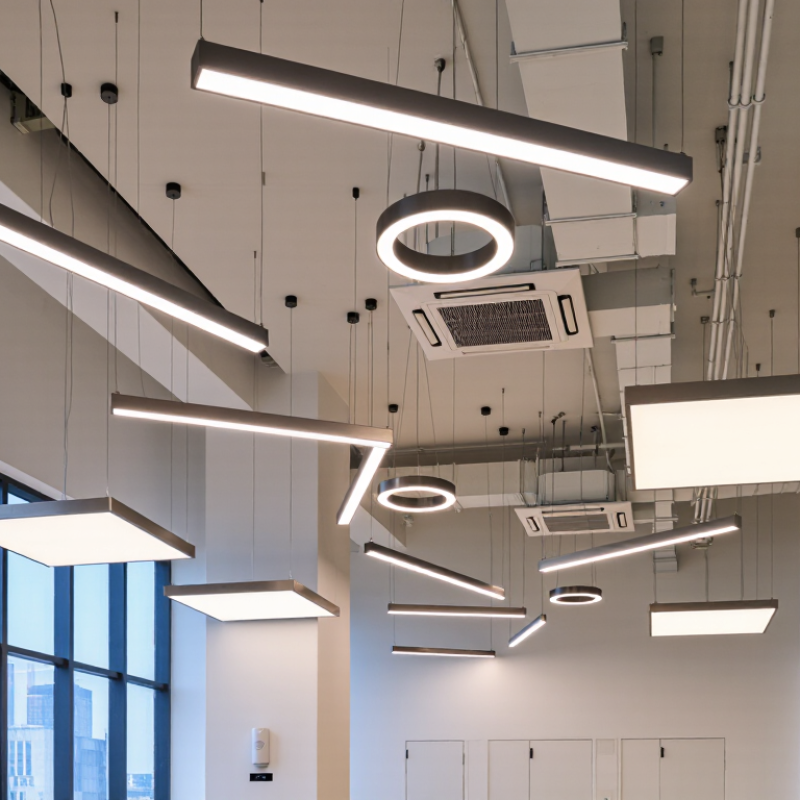
How to Choose Commercial Lighting Fixtures in 2026?
Choosing commercial fixtures should begin with the task, not the catalog. IES RP-1-22, Recommended Practice: Office Lighting, commonly places office task illuminance near 300–500 lux. The correct value depends on visual demand, age, contrast, and room conditions. That range is not a universal command. Reading drawings differs from inspecting tiny components.
Measure the workplane, ceiling height, surface reflectance, and daylight contribution before selecting optics. In a warehouse, high mounting heights and dusty environments can reduce useful light quickly. IES recommendations emphasize maintained illuminance, so maintenance factors deserve attention. A fixture delivering 500 lux on day one may fail the task target later. The uncomfortable part is that many specifications still use initial lumens alone.
Energy compliance must sit beside visual performance. ASHRAE/IES Standard 90.1-2022 controls lighting power density and requires space-based control strategies. The U.S. Department of Energy’s 2023 SSL R&D report notes that laboratory LED packages can exceed 200 lumens per watt. Installed fixtures usually perform lower because of optics, drivers, temperature, and dirt. High efficacy cannot repair glare or poor uniformity. Request photometric files, calculate maintained lux, and review the result with the people performing the task. A small mock-up often reveals mistakes that software hides.
| Commercial Space | Typical Visual Task | Recommended Maintained Illuminance | Uniformity Target (Emin/Eavg) |
Recommended CCT | Color Quality | Glare / Comfort Priority | Suitable Fixture Characteristics | Key Selection Considerations |
|---|---|---|---|---|---|---|---|---|
| Open-Plan Office | Computer work, reading, writing, collaboration | 300–500 lux (28–46 fc) |
≥ 0.60 | 3500–4000 K | CRI ≥ 80; CRI ≥ 90 for premium interiors |
Low direct and reflected glare; target UGR < 19 where applicable | Recessed or suspended direct/indirect linear fixtures with controlled optics | Check screen reflections, ceiling brightness, spacing, daylight contribution, and dimming zones |
| Private Office | Detailed paperwork, screen-based work, meetings | 300–500 lux (28–46 fc) |
≥ 0.60 | 3500–4000 K | CRI ≥ 80 | Low glare and comfortable vertical illumination on faces | Adjustable recessed, surface-mounted, or indirect/direct fixtures | Provide independent controls for ambient and task lighting; avoid bright sources in the field of view |
| Conference Room | Presentations, note-taking, video meetings, face-to-face communication | 300–500 lux (28–46 fc) |
≥ 0.60 | 3000–4000 K | CRI ≥ 80; CRI ≥ 90 for accurate skin tones |
Very high comfort priority; minimize glare on displays and cameras | Dimmable recessed or suspended fixtures with separate presentation and perimeter zones | Use scene controls, blackout compatibility, and balanced vertical illumination for video conferencing |
| Classroom or Training Room | Reading, writing, teaching, projection, group work | 300–500 lux (28–46 fc) |
≥ 0.60 | 3500–4000 K | CRI ≥ 80 | Control glare on whiteboards and projection screens | Dimmable linear or recessed fixtures with independently controlled front, center, and rear zones | Coordinate fixture layout with screens, whiteboards, daylight, and occupancy controls |
| Reception and Lobby | Wayfinding, check-in, reading signs, social interaction | 200–300 lux (19–28 fc) |
≥ 0.40 | 3000–3500 K | CRI ≥ 80; CRI ≥ 90 for finishes and artwork |
Comfortable ambient light with controlled accent brightness | Layered lighting using ambient downlights, linear fixtures, wall washers, and accent lighting | Provide vertical illumination for signage and faces; avoid excessive contrast at entrances |
| Retail Sales Area | Product browsing, label reading, color and material evaluation | 300–750 lux (28–70 fc) |
≥ 0.40 | 3000–4000 K | CRI ≥ 90 for apparel, food, cosmetics, and merchandise color accuracy | Control glare while allowing deliberate visual emphasis | Track-mounted adjustable spotlights, linear systems, and wide-beam ambient fixtures | Select beam angles, aiming flexibility, spectral quality, and dimming based on merchandise type |
| Warehouse Aisles | Picking, barcode scanning, labeling, safe movement | 100–200 lux (9–19 fc) |
≥ 0.40 | 4000–5000 K | CRI ≥ 70; CRI ≥ 80 when labels or product colors matter | Limit glare from high mounting heights and glossy packaging | High-bay or aisle-oriented fixtures with narrow or asymmetric optics | Match optics to rack height and aisle width; consider occupancy and daylight harvesting controls |
| Manufacturing or Assembly Area | Assembly, machine operation, component inspection | 300–750 lux (28–70 fc) |
≥ 0.60 | 4000–5000 K | CRI ≥ 80; higher CRI for color-critical work | Reduce shadows, flicker, and reflections from machinery | Industrial linear, high-bay, or task-integrated fixtures with robust housings | Set the target from the most demanding task; verify stroboscopic effects near rotating equipment |
| Inspection and Quality-Control Station | Surface inspection, measurement, defect detection, fine detail work | 750–1500 lux (70–139 fc) |
≥ 0.70 | 4000–5000 K | CRI ≥ 90; evaluate R9 and special color requirements when relevant | Very low glare; precise task illumination is essential | Adjustable task fixtures with high-quality diffusers, precise optics, and flexible positioning | Combine ambient lighting with local task lighting; confirm contrast, shadow control, and measurement accuracy |
| Corridor and Passageway | Walking, orientation, door and sign recognition | 100–200 lux (9–19 fc) |
≥ 0.40 | 3000–4000 K | CRI ≥ 80 | Comfortable, low-glare illumination with no abrupt dark zones | Recessed, surface-mounted, or wall-mounted linear fixtures with wide distribution | Coordinate with emergency lighting, signage, ceiling height, and occupancy-based controls |
| Stairway | Safe movement, tread and riser recognition, handrail visibility | 100–150 lux (9–14 fc) |
≥ 0.40 | 3000–4000 K | CRI ≥ 80 | Minimize veiling reflections and shadows on stair treads | Wall-mounted, recessed step, or ceiling fixtures providing uniform vertical and horizontal light | Ensure code-required emergency illumination and avoid fixture placement that creates unsafe glare |
| Indoor Parking Garage | Vehicle and pedestrian movement, obstacle detection, wayfinding | 75–100 lux (7–9 fc) |
≥ 0.40 | 4000–5000 K | CRI ≥ 70; CRI ≥ 80 for security-focused applications | Control disability glare at vehicle and pedestrian sight lines | Vapor-resistant linear or garage fixtures with broad, uniform distribution | Specify impact resistance, moisture protection, controls, maintenance access, and emergency operation |
| Healthcare Examination Room | Patient examination, documentation, clinical observation | 500–1000 lux (46–93 fc) |
≥ 0.60 | 3500–4000 K | CRI ≥ 90; evaluate color quality for clinical tasks | Low glare with balanced ambient and examination lighting | Sealed recessed fixtures, indirect/direct systems, and dedicated adjustable examination lights | Consider cleanability, flicker performance, patient comfort, vertical illumination, and infection-control requirements |
| Food Preparation Area | Ingredient handling, cleaning, cutting, food-quality inspection | 500 lux (46 fc) |
≥ 0.60 | 3500–4000 K | CRI ≥ 80; CRI ≥ 90 where food appearance is important | Reduce shadows on work surfaces and avoid reflective glare | Sealed, cleanable, moisture-resistant fixtures with diffused or controlled optics | Confirm ingress protection, impact resistance, cleanability, and local food-service regulations |
Planning note: The illuminance ranges above are practical commercial-design targets commonly aligned with IES task-based recommendations and international workplace practice. Final values should be verified against the current IES Lighting Handbook, applicable local energy and building codes, room reflectances, mounting height, daylight availability, maintenance factor, and the specific visual task. Illuminance values are maintained averages unless otherwise stated.
Compare delivered lumens, efficacy, glare, color quality, warranty, and maintenance needs. Appearance comes later. A bright-looking fixture may still underlight the room.
Request independent photometric files and test a small mock-up before full installation. Measure aisle floors or desk surfaces with a light meter. Drawings can hide uneven spacing.
No. Treat 75% as a project target, not an automatic result. Calculate existing wattage, operating hours, electricity rates, and expected LED use. The first estimate may be wrong.
Occupancy sensors, daylight response, scheduling, and dimming can reduce consumption. Poorly positioned sensors may annoy occupants. People may disable them.
Compare expected operating hours with your building schedule, heat, switching frequency, and cleaning conditions. A 60,000-hour claim equals about 15 years at 4,000 hours yearly. That is only on paper.
Include purchase price, installation labor, electricity, replacements, disposal, cleaning, and lift access. A cheap fixture may require expensive maintenance visits. Look beyond the invoice.
Contact the local utility before ordering equipment. Confirm current applications, eligible products, installation dates, and documentation requirements. Old handouts may mislead you.
Test lighting levels, glare, controls, and occupied-room scenes. Review energy bills after six months. Real results may challenge the original calculation.
Choosing Commercial Lighting Fixtures in 2026 requires more than comparing prices or appearance. Begin by defining the project’s purpose, room layout, operating hours, and visual tasks, then use IES illuminance targets to determine the required light levels. Compare LED fixtures by efficacy, lumen output, distribution, and uniformity, while considering the DOE’s benchmark of up to 75% energy savings compared with traditional lighting. A complete evaluation should also include expected maintenance costs and service life, especially since quality LED systems can last up to 25 times longer than conventional sources.
Next, select color temperature and CRI according to the environment, and assess glare control, flicker performance, dimming capability, and optical design. DLC-compliant performance may support efficiency and rebate eligibility, while compatible controls can further reduce energy use through scheduling, occupancy sensing, and daylight response. Finally, verify ENERGY STAR efficiency requirements, available incentives, warranty terms, installation conditions, and total lifetime value before making a decision. This approach helps ensure the lighting system delivers reliable performance, visual comfort, and measurable long-term savings.